Does not conduct electrical current
A non-metallic composite with electrical insulating properties.
 IPMTECHNOLOGY
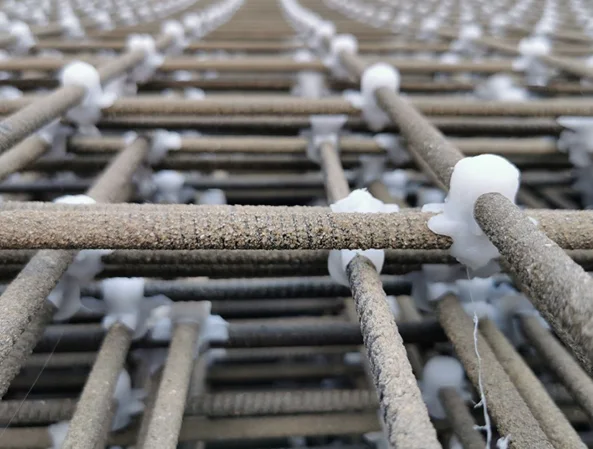
A non-metallic composite with electrical insulating properties.
Fewer separate elements to arrange.
Cell size, dimensions and position are confirmed.
Tanks, coastal structures and concrete exposed to moisture and salts. Mesh suitability for the environment is checked; fiber is evaluated for crack control.
Slabs, pavements and infrastructure elements. Mesh and fiber selection depends on loads, design and service conditions.
Floors, yards and parking areas exposed to impact and wear. Dispersed reinforcement requires a confirmed mix design and appropriate tests.
The same task: reinforcement. Different properties that matter on site.
Does not conduct current
Conducts current
Does not rust like steel
Can corrode in moisture and salts
A lighter material to handle
A heavier material
Elastic behavior until failure
Can deform plastically
A material comparison, not a diameter-for-diameter replacement. The designer checks loads, deflection, connections and service conditions.
Savings go beyond the material price.
A lighter material is easier to unload and move.
Panels are placed to the design, with fewer separate elements to arrange.
We compare material, delivery and labor for your project. A lower total price is possible, but requires a design and a specific quotation.
Request a project cost comparisonBasalt fibers provide reinforcement and the polymer matrix binds them into a composite. The mesh arranges reinforcement in two directions. It is a different product from chopped fibers mixed into concrete.
This is not a steel mesh. The absence of steel avoids its rusting mechanism, but suitability for moisture, chemicals and temperature must be checked against the specific product documentation.
CompCore lists foundations, monolithic elements, road infrastructure, parking facilities, marine works and tunnels. These are potential applications for assessment, not automatic approval for every structure.
Diameter and cell size determine reinforcement per unit area. The designer checks capacity, deformation, cracking and connection details. Commercial diameter comparisons are not structural calculations.
Coordinate cutting, overlaps, connections, supports and concrete cover with the design and supplier instructions. The mesh must remain in its intended position during pouring.
Application, drawing or area, required diameter and cell size, panel dimensions, overlap details, delivery location and schedule. Request the basalt variant’s technical specification and available test documents.
The composite mesh catalogue lists these general configurations. Availability for the basalt variant, weight and delivery time are confirmed on enquiry.
Scroll horizontally to see all columns.
| Diameter | Cell size | Panel size |
|---|---|---|
| 4 mm | 150 × 150 mm | 2200 × 6000 mm |
| 4 mm | 200 × 200 mm | 2200 × 6000 mm |
| 6 mm | 150 × 150 mm | 2200 × 6000 mm |
| 6 mm | 200 × 200 mm | 2200 × 6000 mm |
| 8 mm | 150 × 150 mm | 2200 × 6000 mm |
| 8 mm | 200 × 200 mm | 2200 × 6000 mm |
| 10 mm | 150 × 150 mm | 2200 × 6000 mm |
| 10 mm | 200 × 200 mm | 2200 × 6000 mm |
Tell us what you are building. We will discuss the material and quantity.
Application, quantity and timing help us prepare a relevant response.